Kathmandu. As US President Donald Trump seeks to build a coalition of navies willing to open the Strait of Hormuz, some countries have begun direct talks with Iran on safe passage. The new reality shows that Tehran is now deciding who gets to use the world’s most important energy route, regardless of the military outcome.
Iran’s Strategy in the Strait of Hormuz
Following the February 28 US and Israeli attacks on Iran and the death of Supreme Leader Ayatollah Ali Khamenei, the Iranian military leadership has focused on its most powerful tool – geographic advantage.
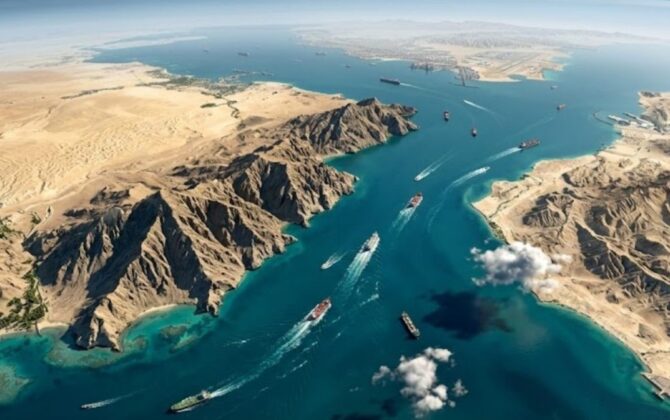
Iran controls the northern shore of the strait, which supplies about 20 percent of the world’s crude oil and natural gas. Its narrowest section is only 33 kilometers wide, making any naval vessel an easy target for an Iranian attack. With insurance companies’ low risk appetite, a few attacks or even threats have increased uncertainty in the market, driven up insurance premiums and brought the waterway to a near standstill. About 20 ships have been attacked since the war began.
Iran’s influence on markets and geography
“Iran has made it clear that they decide who can travel through the strait,” said Andreas Krieg, associate professor of security studies at King’s College London. “They have become the gatekeepers of this important junction point. This further elevates Iran’s position in the geography of the Gulf.”
Oil prices have risen above $100 a barrel and natural gas prices have risen to $40. This has forced countries to open their largest emergency reserves in history.
Trump’s attempts and failures
Trump initially floated the idea of ordering the US Navy to secure shipping lanes. He then asked some countries to send warships and warned NATO members. But most countries refused or responded inconclusively:
Japan announced it would not send a ship
Australia said it had no plans to send a ship
Britain and Germany denied direct involvement
Countries held talks with Iran
But some countries took a different approach. For example:
Two Indian gas tankers passed through the strait after talks with Tehran and a phone call between Narendra Modi and Massoud Pezizkian
Ships from Pakistan, Turkey and China also passed
Italy and France also tried to find a possible deal with Iran
Although the number of ships on the route is still only 3 percent of normal, there has been an increase in “permission-based traffic” through Iranian territorial waters.
Iran’s geographical advantage
Iran has mass-produced drones, the ability to attack tankers from small ships, deploy mines and other guerrilla-style tactics. Experts say that laying mines can only hinder itself. That is why Iran retains the power to choose its own route.
Foreign Minister Abbas Araghchi has made it clear that the military has the final say on who is allowed to use the route.
Strategic and economic implications
Government supporters have begun to present the Strait of Hormuz as a strategic bargaining chip beyond war, which can be used to demand compensation, sanctions relief or broader economic benefits.
A recent drone attack set fire to the port of Fujairah, allowing oil exports to be diverted around the strait. Yemen’s Houthis also have the ability to block the Bab al-Mandeb Strait.
Limited military options
The US military has already used 2,270 kg (5,000 lb) of bunker-busting munitions to pressure the strait to close. Trump has ordered thousands of Marines to the Middle East. Some analysts have suggested that the US military could seize Kharg Island.
But since Kharg Island is 500km from the strait, its capture would not have a major impact on opening the strait. If Iran sees its main terminal being captured, it could also consider placing mines in the strait.
According to Krieg, ‘The issue of the Strait of Hormuz is not really a military one. It is a market issue. Trust cannot be restored through military means, only through diplomatic means.’
(Translation of an article by journalist Virginia Pietromarci from Al Jazeera)